Chels
We have a habit of thinking of poetry as static; as just the ‘greats’ (the long dead). When we think of poets, we think of Shelley, Byron, and Keats. If we’re pushed for a more diverse answer, we tend to go for Dickinson, Neruda, Sylvia Plath or Langston Hughes. All of these poets have one thing in common – their works have been around for ages. It’s as if we see poetry as a thing of the past – and art form once rife with artists, and now a time capsule to the past.
Even the poets we’d consider modern are not as contemporary as we’d think. One of my favourites is Mary Oliver, who last published almost a decade ago. We often study Carol Ann Duffy in school, but we focus on her 1999 collection The World’s Wife. These poems feel contemporary, and in a sense they are (especially compared to Shakespeare and Chaucer), but a lot changes in a decade or two or three, and while we respect the poems we already know, those that are already famous, we have a terrible habit of rejecting modern poetry.
It almost feels wrong to see modern references in poetry. IPhones feel anachronistic to the form. Poetry is not stuck in time, despite what we think, and poetry can evolve. The poets of the past that we love made references to their time that perhaps felt too modern in comparison to their predecessors. So many wartime poets are celebrated for their works now – but did their audiences feel uncomfortable by the mention of new weapons or wartime lifestyle changes the way we do about phones and apps and modern politics in current poetry?
Of course, we are not the first generation to bristle at evolving poetic style – free verse was not immediately embraced by the masses, and the Modernists experimented with style and form in a way that is still controversial a century on.
This month, I read Brian Bilston’s Alexa, what is there to know about love?. Published in 2021, it’s the most contemporary poetry collection I’ve read thus far in my life. I really enjoyed the poetry inside – but I expected I would; I’d seen some of his works recommended in the online poetry community. Bilston’s works explore love from a contemporary perspective but draw on references to literature of the past. I did consciously try to focus on modern references – the supposed anachronisms of present-day poetry. Not to criticise them, but to examine my own aversion to them.
‘First Date’ contains the lines
You praised a revival of Pinter’s Dumb Waiter.
I nodded along. I should google that later.
Shakespeare wouldn’t have googled anything in his sonnets, and yet, ‘First Date’ was one of my favourites of the collection. Another favourite, ‘Gun Fight in the Last Chance Saloon’ references slug repellent, quiz shows, mobility scooters, and a stairlift. Bilston’s poems are incredibly funny – they deal with love and heartbreak in the modern era (‘Status Update: A Lonely Cloud’ puts a lot of emphasis on Candy Crush), but his poems are not just charming and funny (though, even if they were, I would still love them).
The most poignant of the collection, I think, is ‘Three Postcards’. It’s interesting – of all the poems, this is the one that could have been written a hundred years ago.
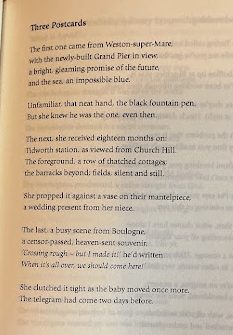
The poem paints an image in just six stanzas, telling the story of a young couple whose life together was upended by the war. It could easily sit alongside Tennyson and Owen’s great poems of war. In fact, I’d like to hope that it will be studied in English classes one day. Instead, it joins some of the great contemporary poetry.
The collection is split into four sections – the first and fourth deal with love and the second with literature. The third section, my least favourite, is the most overtly political.
While I found references to modern technology no issue, I struggled with a lot of the political poems. I’m not sure why – I don’t consider myself to be apolitical, and I also acknowledge that poetry has been political since the beginning of the form. I’m also more than happy to say that the poems are objectively good. They don’t feel out of place from the rest of the collection. I think, perhaps, I’m just not the target audience for overtly political poetry. It has not been long enough since Brexit happened that I can properly enjoy ‘57 Varieties’ of the word.
Before my venture into Alexa, what is there to know about love? I was somewhat hesitant to engage with contemporary poetry. I’d explored some, at university, but at risk of saying something too controversial, I think a lot of the poems lay in a position of awareness that they were modern poems, but also a desire to be considered a classic. I know that every word in poetry is deliberate, but it felt too much like reading deliberately chosen words, and less like reading a creative work.
Going forward, I’m going to try and engage more with contemporary poets. If you have any recommendations, please let me know!

