Chels
Opening lines are maybe the most important part of a book for me. Not for any deep or profound reason, just that I make a conscious effort not to DNF a book, with one exception. If I don’t feel motivated to continue a book after the first few sentences, I can swap it out for another. In fact, the book that started this rule is still on my bookshelf, unread. I can’t bring myself to get rid of it, even though it’s been a good decade since I tried to read it, because I’m genuinely very interested in the concept, I know I just picked it up at the wrong time. The first few lines were, as I remember, quite a fight to get through, very dense in both vocabulary and information.
That’s not to say that I think all opening lines should be snappy or even short, or plunge you straight into the action. The opposite, in fact. One of the most iconic opening lines of all time, ‘It is a truth universally acknowledged, that a single man in possession of a good fortune, must be in want of a wife’ tells us nothing of the characters or setting, doesn’t throw us into the action, and without reading the rest of the novel, might be mistaken as telling us nothing of the plot. And yet, it sums up Pride and Prejudice perfectly.
This week I want to take a look at the opening lines of some of my favourite novels and explore just what makes them so great. Or, perhaps I’ll discover that they aren’t so great. We’ll see.
Frankenstein
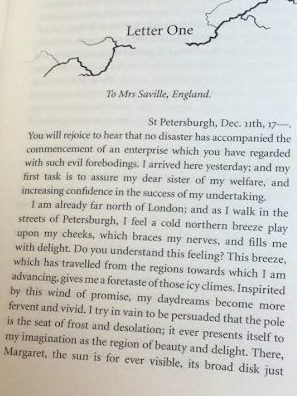
It only feels right to start with my all time favourite. The first line comes from a letter written from Robert Walton to his sister, Mrs Saville, whose correspondence acts as the framing for the main story.
You will rejoice to hear that no disaster has accompanied the commencement of an enterprise which you have regarded with such evil forebodings.
Even without my biased hat on, it’s hard not to say this opening line is excellent. Walton is a mirror of Frankenstein (the doctor, that is, not the creature), an explorer searching for discovery in the Arctic. His sister has warned him against his pursuit of discovery (the evil forebodings), and, at the point in his journey where we are introduced to him, nothing has yet gone wrong, he exhibits the confidence we later see in Victor.
From the opening line, Shelley frames Walton as a foil for Victor. They both head down the same path of passion bordering obsession with scientific discovery. It’s inevitable that Victor’s story will end in tragedy – especially to readers now, when we’re so familiar with the Frankenstein story, but Walton can be saved. By framing the story within Walton’s letters, further stakes are added.
Also, on a less analytical note, evil forebodings is just a great phrase to set the scene for some gothic horror.
The Hunger Games
When I wake up, the other side of the bed is cold. My fingers stretch out, seeking Prim’s warmth but finding only the rough canvas cover. She must have had bad dreams and climbed in with mother. Of course she did. This is the day of reaping.
Technically, this is the first few sentences, but I feel like I have to make an exception. The Hunger Games is a really great book, one that never really feels like a book for children, but at the same time, doesn’t alienate its younger audience.
From the first lines, there’s plenty we can infer, but plenty of questions raised. Prim is presumably a child, a sibling to the narrator. The physical closeness of sharing a bed implies an emotional closeness. The reaping, presumably, is a bad thing, if the narrator associates it with Prim’s nightmares.
The key to the appeal of these opening lines, though, in my opinion, is that we are never told any of these things. It’s especially common in books for younger audiences, the heavy handed exposition, but Suzanne Collins doesn’t tell us the reaping is bad, instead, we infer it. The reaping, presumably, will be the catalyst to the story, and we will discover what it is when we’re supposed to.
The specific language used sets the scene of the dystopia, the ‘cold’ bed and the ‘rough canvas’, both of which juxtapose Prim’s warmth. This is a spoiler-free analysis, though, so I’ll say no more on Prim.
Anna Karenina
Happy families are all alike; every unhappy family is unhappy in its own way.
Anna Karenina follows some quite unhappy families. Although, I will say, in many cases, the unhappiness in Anna Karenina is driven by adultery – so perhaps the families are more alike than the opening line suggests. Still, this line sets the tone for the next 300,000 or so words. Anna Karenina is very long, and quite bleak, but it’s true that happy families are all alike, and it’s the misery and conflict that makes the novel so enjoyable.
Bridget Jones’ Diary
Famously a retelling of Pride and Prejudice, Bridget Jones’ Diary parodies the opening line in a way that perfectly captures the tone of Helen Fielding’s novels.
It is a truth universally acknowledged that when one part of your life starts going okay, another falls spectacularly to pieces.
The play on Pride and Prejudice’s iconic opening line reinforces the link between the two works, and is soon followed by the introduction of Mark Darcy. Austen fans know roughly what to expect, but with a new 90s London setting.
I imagine that Austen’s ‘a single man in possession of a good fortune, must be in want of a wife’ would have been a relatable concept in her time, although it’s more the opposite these days. Fielding takes the idea of a relatable statement and brings it into the present. I think a lot more of us can relate to Fielding’s truth universally acknowledged these days.
Again, the opening line perfectly summarises the novel – it’s pretty much how we see Bridget’s life play out over the course of her diaries.
Nine Perfect Strangers
‘I’m fine,’ said the woman. ‘There’s nothing wrong with me.’
Nine Perfect Strangers is a novel that throws you right into the middle of the action, depicting as-yet-unnamed Masha suffering a cardiac arrest. This event is the catalyst to the novel; it influences Masha to open her health spa.
Not only does the opening line sum up Masha’s attitude to her own health (before her change of life, that is), it’s a nod to the health spa guests and their own attitudes.
Everyone at the spa during the ten day retreat is deeply troubled by something in their life, but like Masha, they are reluctant to admit the extent of their troubles. I’m keeping this as spoiler-free as I can, but it’s safe to say that even after her lifestyle change, Masha is not necessarily free from her own troubles.Nine Perfect Strangers is a story of secrets and suspense, and I think that opening with Masha’s denial is a perfect way to signal what’s to come.
Did I miss any of your favourite opening lines?
 Nonsense & Lit
Omg Nine Perfect Strangers! That book was so wild, I loved it.
I think my absolute favorite first line is from The Great Good Thing by Roderick Townley, “Sylvie had an amazing life, but she didn’t get to live it very often.”
LikeLiked by 1 person
It was so good – I was so surprised to see a lot of lukewarm reviews on goodreads.
Oooh I’ve never read that one – but from the opening line I’m intrigued
LikeLiked by 1 person