
Chels
Wuthering Heights is in the zeitgeist lately, mainly because of the trailer for Emerald Fennell’s new adaptation and controversies surrounding it. Putting my personal thoughts on Fennell’s work aside, there’s a lot that the trailer (and, presumably, the film) gets wrong. The obvious is the ‘colourblind casting’ which has Heathcliff, who is referred to as not white throughout the novel, who is a victim of racism by the other characters, portrayed by a white man, and Edgar, who Heathcliff wished to look like because of the racism he faced, and who looked down on Heathcliff because he was not white, portrayed by Shazad Latif, who is of Pakistani descent. Interestingly, Edgar’s biological sister is still portrayed as white, but that seems to be the standard of ‘colourblind’ casting these days. It’s just very bizarre to me, in a story that is largely about race, that the race of actors be ignored. Because it’s not like this colourblind casting has increased diversity from the novel – there’s still only one character that’s not white, except now, rather than the male lead (and, the whole point of Heathcliff’s alienation), it’s a minor character. (That being said, it’s not actually bizarre – it’s quite clearly a result of Hollywood’s institutionalised racism.)
Aside from that critique, I think the main issue is adapting the book, a Gothic romance, into a romance. We tend to look at things through a modern romantic lens. Wuthering Heights is not a sexy novel – not at all how the film portrays the story. A lot of criticism of the novel talks about the toxic relationships, about how the lovers are not good people, and shouldn’t be together. That takes a very 21st century approach to the novel, where characters seem to need to be wholly good, with forgivable flaws. The romance should be pure, at least emotionally, but with enough spice to be entertaining. This isn’t a criticism of modern romance novels – it’s just that a Gothic romance isn’t a romance in the modern sense, it’s something much different. It’s hard to view Wuthering Heights through this lens, because it doesn’t have the same intentions as modern romance novels, it doesn’t serve the same purpose.
So, what is a Gothic romance?
There are two key elements to a Gothic novel: the aesthetic, as it were, and the commentary. In terms of the aesthetic, the Gothic is all about old country houses with untouched rooms, gloomy cloud-covered hills, sodden clothing and cold, dark nights. If the settings and atmosphere aren’t unnerving enough, there’s quite often a supernatural element – a ghost or spectre, or even just a human character that’s haunting enough to frighten readers and characters.
While the spooky aesthetic is key, it’s also not the whole point of the Gothic. The setting acts as a veneer for the social commentary that a Gothic novel provides. Through hauntings and tense familial relationships, these novels explore themes of class, race, alienation and poverty. Gothic literature was hugely popular in the 18th and 19th centuries, during a time of social changes, revolution, and industrialisation. These novels captured the fear of change, the loss of the past, and the cultural conflicts that came about. Rather than very on-the-nose realism, the gothic elements – the unusual – are used to examine social norms and expectations.
Wuthering Heights was new to me, aside from cultural references and Kate Bush’s 1978 song. While I’ve suggested that people lean too far into modern expectations of romance, my assumptions went in the opposite direction. Based on the other Gothic novels I’ve read (though most have been Gothic horror, rather than Gothic romance), I had expected a lot more supernatural elements than the book had. In fact, outside of Mr Lockwood’s framing narrative, there’s pretty much nothing supernatural in the novel. From Catherine’s death I was expecting to read about her ghostly figure haunting Wuthering Heights, desperately trying to return to Heathcliff, but page after page, it never came. That was the biggest surprise of all to me; how normal the events of the novel were. Well, as normal as they can be in a family plagued by bitter feuds and seemingly disregarded incest. Lockwood’s brief experience at Wuthering Heights was the most supernatural, and as far as the written text, he’s the only character to have contact with Catherine’s ghost. I definitely was expecting to read more of Heathcliff’s interactions with her ghost, and more of their interactions in general, but since the story was told from Nelly Dean’s perspective, those intimate interactions are left to the imagination.
A different haunting
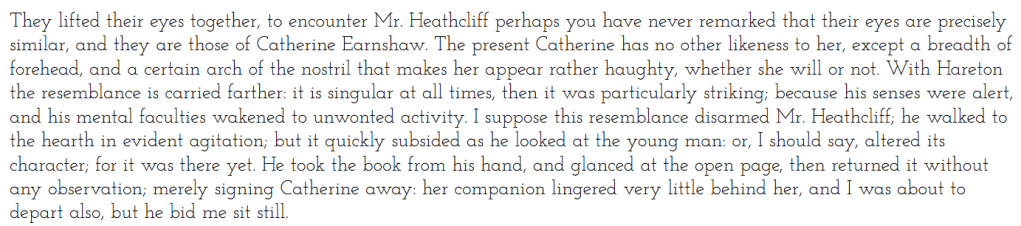
I realised, however, that while there wasn’t a haunting in the traditional sense, Heathcliff absolutely was haunted by Catherine. On her death, Catherine left behind her newborn daughter, Cathy, and the young girl is described as almost her double. Heathcliff and Catherine grew up together, so seeing young Cathy grow up, a vision of her mother, was almost a repetition of his own past with Catherine. Hareton too, though he was Hindley’s son, was said to look just like his aunt.
The real haunting in Wuthering Heights comes from the young Cathy and Hareton; reminders of a past that Heathcliff tries to forget. It almost seemed like Cathy’s presence at Wuthering Heights was what drew him to his anguish, and seeing Cathy and Hareton together, both echoes of his love, was the catalyst for his death. Heathcliff himself said, on Catherine’s death, that the murdered do haunt their murderers. Catherine certainly haunted Heathcliff for the remainder of his life – not as a spectre or spirit, but in the Lintons and Earnshaws left behind.
Wuthering Heights was not the novel I expected, but at the same time, it made perfect sense. It didn’t need ghostly encounters, and it certainly didn’t need steamy romance. I think we have a bad habit of viewing classic novels through a contemporary lens, rather than appreciating their value in their time. Because yes, by today’s standards, it certainly wouldn’t be considered a typical romance, but the Gothic romances didn’t serve as fantasy, they served as critique. They were deliberately transgressive, and they sought to examine cultural norms.
 Nonsense & Lit