Chels
How is it already the end of February?
To conclude my literary love stories series, we’re talking about Vita Sackville West and Virginia Woolf. Of all the relationships I’ve talked about this month, Vita and Virginia are the couple I’ve known of for the longest – I included the 2018 film Vita and Virginia in my undergraduate dissertation. Writing this, I realised that was three years ago, which is a pretty scary thought. Regardless, Virginia Woolf had a pretty big influence on queer literature, and, in fact, queer film, so it only feels right to look at her own love story.
*most of my information for this love story comes from Love Letters: Virginia Woolf and Vita Sackville-West, introduced by Alison Bechdel.
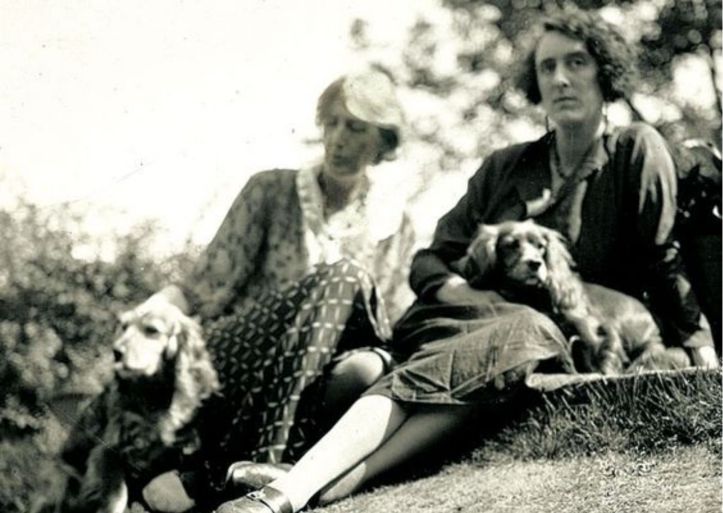
Vita and Virginia first met in 1922. At the time (and, in fact, throughout their relationship), Virginia was married to Leonard Woolf, and Vita to Harold Nicolson, although Vita and Harold famously had an open marriage, with both of them having several affairs, often same sex relationships.
Vita was well established by this point, although ten years younger than Virginia, who was not quite so well known. Their accounts of their first meeting do a good job of capturing what would be to come in their relationship – in her diary, Virginia seemed wary of Vita, but impressed by her. Vita, on the other hand, declared her love for Virginia in a letter to Harold. Although she did note that ‘she dresses quite atrociously’.
In 1924, Virginia and Leonard moved to Tavistock Square, and Vita was one of their first visitors. In the same year, Virginia invited Vita to submit a work to the Hogarth Press – the publishing company she shared with Leonard. Vita obliged, and wrote Seducers in Ecuador, marking the beginning of their 17 year exclusive publishing relationship. She even went as far as to dedicate the book to Virginia.
It’s interesting, really, to see the way their husbands reacted to their relationship. Leonard and Vita seemed, to me, to act as a team – they both cared deeply for Virginia and nursed her through her frequent illnesses. Harold, on the other hand, seemed less approving, which is odd to me, since both Harold and Vita frequently had affairs. But Vita wrote to him often to assure him that she wasn’t in love with Virginia in that way, or that she wasn’t ‘in a muddle’ with her, which was their term for an affair. Although the book doesn’t include Harold’s letters to Vita, her responses suggest that he wasn’t keen on this particular entanglement.
At a party to see in the year 1926, Clive Bell, Virginia’s brother in law, asked Vita outright if she had ever gone to bed with Virginia. In a letter to Harold, Vita said that she perhaps denied it too passionately. Later, in one of her attempts to assure Harold that he should not feel threatened by her relationship with Virginia, she confessed to having gone to bed with Virginia.
In the same year, Vita followed Harold to Tehran, and during this trip, their most passionate letters in my opinion were exchanged. They wrote often, but the distance meant that their letters took weeks to arrive. It’s during this trip that Vita wrote, to Virginia, ‘I just miss you, in a quite simple desperate human way’. Her letters were incredibly romantic, and full of yearning.
Vita began an affair in 1927 with Mary Campbell which she attempted to conceal from Virginia, which Virginia was quite jealous about. In a letter to Vita, she wrote ‘If you’ve given yourself to Campbell, I’ll have no more to do with you, and so it shall be written, plainly, for all of the world to read in Orlando.’ It’s interesting, though, because a lot of people talk about Orlando as a kind of retaliation by Virginia, or an attempt to slight Vita, but to me their letters throughout her writing suggest otherwise. To me, at least, it seemed that Virginia wrote Orlando to honour Vita and their relationship, and leading up to the novel’s publication, the pair worried that it would confirm their relationship and result in the loss of their friendship, so much so that just before the publication, the pair holidayed in France, alone together.
In the early 1930s, Vita and Virginia seemed to grow less close, exchanging fewer letters (though many from this time are missing) and visiting one another less often. Virginia formed a close friendship with Ethel Smyth, who seemed to be in love with her, but Virginia did not reciprocate. Vita continued to travel, and took up gardening. They both continued to write, though.
In 1935, Virginia wrote in her diary that she believed her friendship with Vita was over. Not due to any ill-will between the women, just that they had grown apart. Things changed, though, in 1937, when they were reunited, and their letters and visits became frequent again. Both women were grieving – Vita lost her mother in 1936, and Virginia her nephew in 1937.
They quarrelled for the first time over Virginia’s Three Guineas, although to me it seems to have been a misunderstanding. Virginia was happy to disagree on matters of opinion (and quite frequently they disagreed on the quality of their own works – usually neither could be convinced that the other liked their newest work as much as they claimed). This time, however, Virginia misunderstood Vita’s letter. While Vita disagreed on Virginia’s conclusions, Virginia believed Vita was accusing her of dishonesty, and took offence. Of course, after a few letters, they returned to the same page and continued their mutual admiration.
Reading their writing on the impending war was very eerie to me in the sense that it felt oddly more private than their declarations of love, it felt like something I shouldn’t have had access to. Both of them worried, of course, but particularly Vita, who had two adult sons. They still wrote to one another, and talked on the phone, but between petrol rations and the lack of safety, as well as Virginia and Leonard’s retreat from London to Sussex, they met in person less often. Still, Vita sent food from her farm to the Woolfs – they were particularly grateful for her butter.
Regarding the impending declaration of war, in the summer of 1939 Virginia wrote ‘all the same I should like another ten years.’ Sadly, less than two years later, she died. Vita and Virginia met for the final time in February 1941, and exchanged their final letters in March, a month before Virginia took her own life. In a letter to Harold, Vita believed, or perhaps wished, that if she had been there, she might have saved Virginia from drowning.
Vita lived a further two decades, and until her death, her desk held two photographs. One of Harold, and the other, Virginia.
 Nonsense & Lit
[…] February, I used Love Letters: Virginia Woolf and Vita Sackville-West to write my Literary Love Story of the couple, and I got so invested in Woolf’s writing that I followed it up with Mrs Dalloway, […]
LikeLike