
Chels
How do I love thee? Let me count the ways.
Not all of my favourite literary love stories are scandalous. Elizabeth Barrett Browning and Robert Browning are purely romantic. Maybe too romantic, in fact – there’s an abundance of poems and love letters that survive today to show us just how in love they were.
*I haven’t been able to get my hands on a copy of Dared and Done by Julia Markus, so I’m relying on the things I’ve been able to find through reviews and extracts of the book.
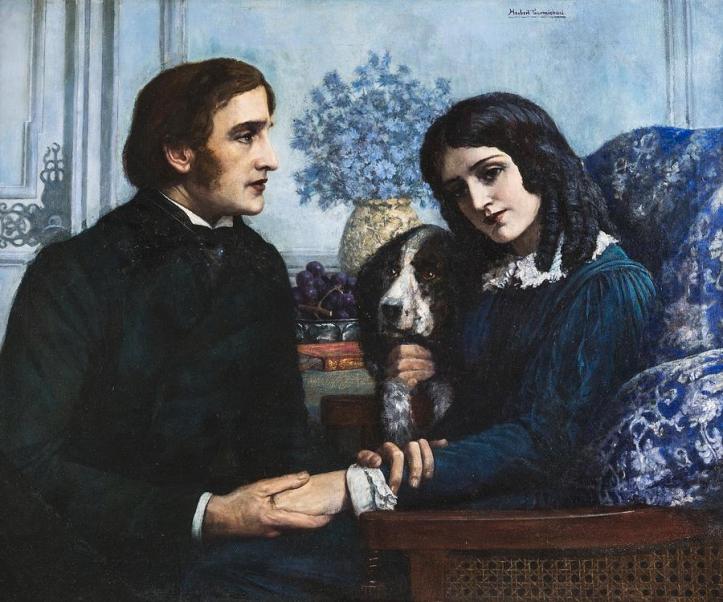
The closest thing this couple has to a scandal is the fact that Elizabeth’s father, Edward Moulton-Barrett, didn’t want her (or any of his children, for that matter) to marry.
Elizabeth became ill in her teenage years, and she became a bit of a recluse, even more so after the death of her brother. Still she wrote and published her works, and was highly regarded as a poet. So highly regarded, in fact, that her first letter from Robert ended “I do, as I say, love these books with all my heart — and I love you too.”
He first wrote to her in January 1845. She was 38, and presumed she’d be a spinster for the rest of her life, and he was six years younger. They wrote back and forth for a while, and finally met in person that summer. She was clearly quite taken with Robert, because by that point in her life, she rarely met with people outside of her circle of family and close friends.
They courted largely in secret. Elizabeth’s father would not have approved of their relationship, and Robert’s family were reluctant to accept his relationship with Elizabeth due to her ongoing illnesses. However, in my opinion, it was Elizabeth’s illnesses that finally allowed them to marry. In the summer of 1846, Elizabeth’s doctor advised her to travel to Italy for her health, but her father forbade the move. So, in quite the brave feat, Elizabeth and Robert secretly married in London, and didn’t tell her father until after they had escaped to Pisa.
Her father was, as you can imagine, furious, and disowned Elizabeth. The rest of her family did eventually forgive the couple, though.
Italy was good for Elizabeth’s health. The couple eventually settled in Florence, and Elizabeth wrote prolifically. Robert wrote less often, and instead explored art and sculpting. They were both inspired by Italy, though, and by their marriage. Elizabeth’s Sonnets from the Portuguese collection, which includes one of her most well known works – How do I love thee?, was clearly inspired by her love for Robert.
They clearly loved one another dearly, and while they avoided scandal and infidelity, they also weren’t boring. They were both passionate, and headstrong in their opinions. Elizabeth wrote to her brother regarding their opposing beliefs that ‘Robert & I have fought considerably on these points’. Robert’s letter to her brother two days later painted the disagreement as less intense.
Their marriage also wasn’t without heartbreak. Elizabeth suffered three miscarriages before the birth of their son, Robert Barrett Browning (known affectionately as Pen) in 1849, three years into their marriage. They adored Pen, but Elizabeth wished for a second child, particularly a daughter. She miscarried again after Pen’s birth, and following that, accepted that he would be her only child. Although she clearly loved her son, it’s also clear that she enjoyed the thought of having a daughter – she relished in him being mistaken for a girl in his early childhood. She also insisted on keeping his hair long and dressing him in velvet and lace, which was more common in girls and young boys, later into his childhood – another source of disagreement between Elizabeth and Robert.
Sadly, Elizabeth’s health declined, and she died in Italy in 1861, after fifteen years of marriage. She died in Robert’s arms, and he grieved so strongly that he couldn’t bear to remain in Italy without Elizabeth. However, he did take the opportunity to cut Pen’s hair and dress him in more masculine clothes, possibly against Elizabeth’s wishes. Robert continued to raise Pen in London, and his works began to gain popularity.
 Nonsense & Lit