Karly
Come one, come all, it’s happening again: Karly thinks she’s a blogger. I’ve always felt weird writing about myself in the third person, but I couldn’t resist including the Taylor Swift reference. This post will serve as an introduction to some of the content you will be seeing on this blog as well as to myself.
As the title would suggest, I am a linguist and a certified yapper it would seem. I don’t know if I should say modern linguist, as I did do Modern Languages as well, but for practical purposes, after years of just being a ‘wannabe linguist’ (with an old Studygram account to prove it), I can finally publicly drop the ‘wannabe.’
Now, when I say linguist, I should clarify I’m not the type of person who enjoys pointing out grammar mistakes in social situations, although, I’ll admit, as a non-native English speaker, I do sometimes overthink certain things, especially when I’m unsure if I’ve said something correctly or if I’ve made a subtle error in usage or how native speakers use the structures I learned growing up. What really excites me, though, is sociolinguistics. This is where my interest truly lies. I love exploring how language functions in society, and how factors like culture, social status, and identity shape the way we speak. Pragmatics, the study of language in context, fascinates me because it reveals how much of communication is unspoken, influenced by social norms, expectations, and shared knowledge. For example, the way a simple greeting can vary depending on the context, or how the tone of voice changes the meaning of a statement, it’s these subtle, yet significant, aspects of communication that I find captivating.
Another area I find particularly engaging is the study of accents and regional variations. Growing up bilingual in English and Spanish, I’ve always been attuned to the nuances of how different accents can convey so much about a person’s background or geographical origin. It’s not just about the sounds we make; it’s about what those sounds represent. The way we speak often reflects our identity, our upbringing, and the places we come from. Having lived in Ireland and Scotland, I’ve seen firsthand how accents influence perceptions and how language shifts across regions.
Language acquisition is another area I’m passionate about. I’m deeply interested in how children and adults alike learn languages, how they acquire vocabulary, grammar, and pronunciation, and how their brains process new linguistic input. The process of learning a second language, especially as a non-native speaker, has given me unique insights into the challenges and joys that come with mastering a new language. I’m constantly intrigued by how speakers of different languages approach the task of acquiring a new system of communication, and the ways in which this process varies from person to person.
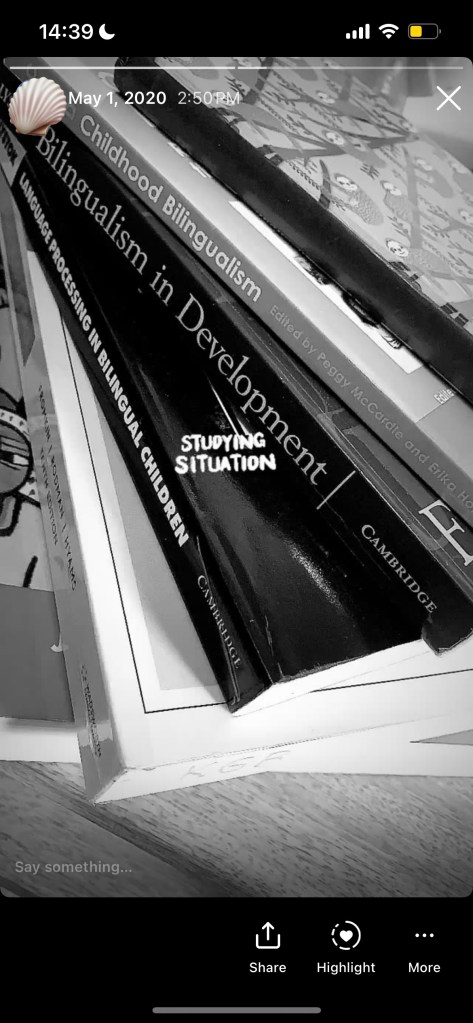

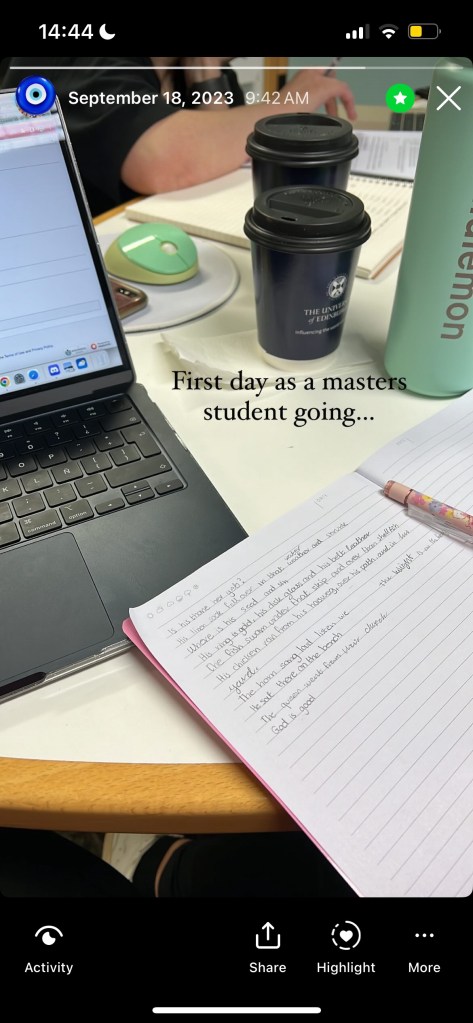
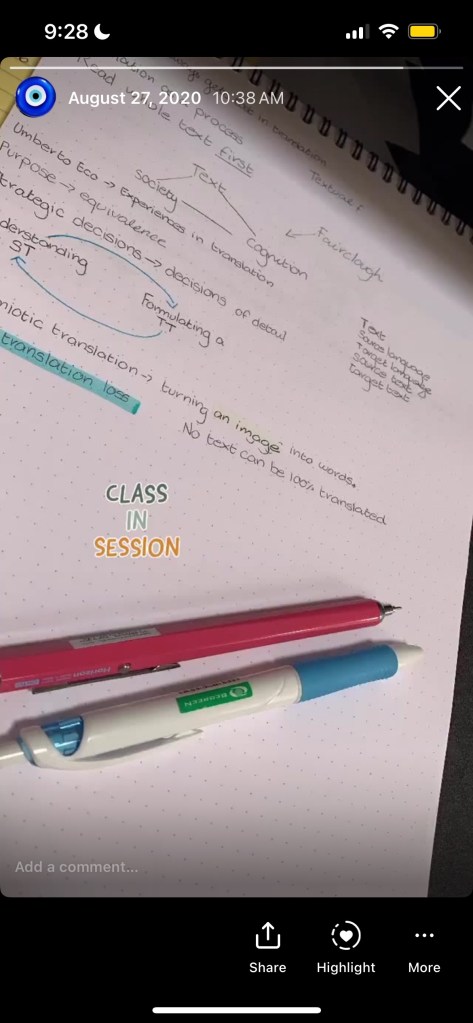
Lastly, I’m drawn to discourse analysis, which involves studying the structure and function of communication in its various forms, from casual conversation to formal written texts. Discourse analysis allows me to examine how we construct meaning through language, how we navigate social dynamics through our words, and how language reflects power structures and ideologies in society. Out of all the branches above mentioned, this might be my favourite, as it can really overlap with literature, which is another field I’m extremely passionate about. I love dissecting Taylor Swift’s lyrics, some of my favourite films’ dialogue, and even poems and prose. Probably not what formal discourse analysts are doing, but it makes me happy.
I’d be lying if I said my relationship with my undergraduate and postgraduate degrees was smooth, especially since I finished my undergraduate degree during the lockdown. The shift to online learning and the isolation made it hard to stay motivated, and there were times when I questioned my path. But despite the challenges, I pushed through and completed my undergrad, and then I decided I hadn’t quite had enough, so I thought, “Wouldn’t it be fun to pursue a postgrad abroad?” Spoiler alert: for me in particular, it wasn’t. But in the greater picture, it was a fun learning experience that I can certainly talk about in the future.
Today, I feel more confident talking about the knowledge I’ve gained, both in theory and in practice. Linguistics is surprisingly versatile, and the lessons I learned are not only relevant to academia but also to real-world applications. I’m excited to share what I’ve learned, whether it’s exploring language’s role in daily life or applying my studies to topics I’m passionate about. In short, I’m putting my degree to good and practical use.
AND, that’s not all, because I will not only be yapping about linguistics but also other things that I find interesting or even just visually pleasing, like junk journaling. Has anyone tried that?
PS: If you want to know more about me or see what I’m up to when I’m not writing for the blog, you can follow me here and here.
 Nonsense & Lit